CAT 2026: Last 30 Days Strategy (Day-by-Day Plan, Mock Schedule and Free Checklist)
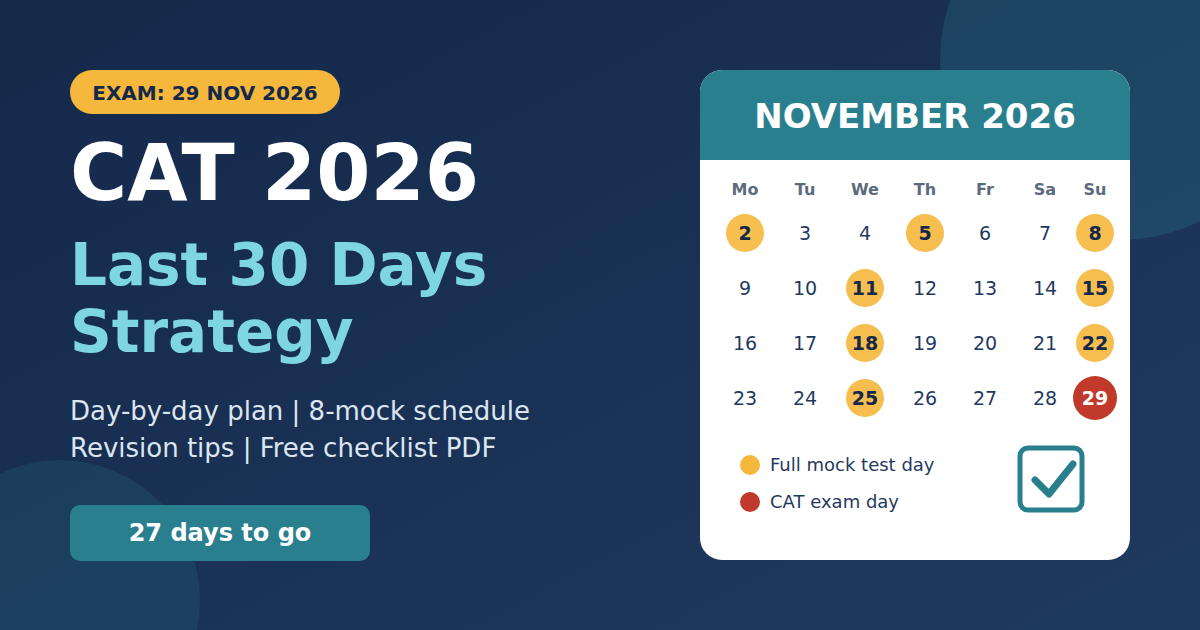
CAT 2026 is on Sunday, 29 November 2026, conducted by IIM Indore. Today is 2 November, so you have 27 days of preparation left, plus exam day. That is enough time to move your percentile, but not enough to waste any of it.
This guide is a plan, not a pep talk. It has four parts: the plan itself, a mock schedule, revision rules, and a printable checklist.
First, know what you are preparing for
- The paper has 68 questions in total, the same count as the last two years.
- There are three sections: VARC, DILR and QA. Each section gets 40 minutes, so you cannot borrow time from one section for another.
- Every wrong MCQ costs 1 mark, a correct answer earns 3, and typed (TITA) answers have no negative marking.
- The exam runs in three slots. Your admit card, which is available from 4 November, tells you which one is yours.
What this means for you: CAT rewards smart selection of questions, not solving everything. In the last 27 days, your job is to protect accuracy, choose the right questions, and stay calm.
The 5 rules for the last 30 days
- No new resources. Stick to one mock series and your own notes. Switching books now only creates panic.
- Mocks teach you only if you analyse them. Spend as much time analysing a mock as you spent writing it.
- Fix the biggest leaks first. Do not try to master all of Geometry. Fix your three weakest topics in each section.
- Practise like the real exam. Take mocks at your actual slot time, on a computer, with the same break rules.
- Sleep is part of the syllabus. A tired brain loses more marks than a missed topic.
Your daily routine (about 7 to 8 hours)
| Time block | What to do |
|---|---|
| Morning (2 hrs) | QA: concepts, then timed practice |
| Afternoon (1.5 hrs) | DILR: 2 full sets, timed |
| Evening (1.5 hrs) | VARC: 3 RC passages + 1 verbal ability set |
| Night (45 min) | Update your error log and read one editorial |
On a mock day, the mock replaces the morning and afternoon blocks. Analysis takes the evening.
Day-by-day plan (2 to 29 November)
Phase 1: Diagnose and patch (2 to 8 Nov)
| Day | Date | Focus |
|---|---|---|
| 1 | Mon 2 Nov | Mock 1 (diagnostic). Full analysis. List your 3 weakest topics per section and start your error log. |
| 2 | Tue 3 Nov | QA Arithmetic (percentages, ratio, mixtures, TSD, time and work). 2 DILR sets, 3 RCs. |
| 3 | Wed 4 Nov | QA Algebra (equations, inequalities, functions, logs). Para jumbles and summary. Download your admit card. |
| 4 | Thu 5 Nov | Mock 2. Analyse in the evening. |
| 5 | Fri 6 Nov | QA Geometry and Mensuration. 2 DILR sets. 3 RCs. |
| 6 | Sat 7 Nov | QA Number System and Modern Maths (P&C, probability). DILR arrangements. Verbal ability. |
| 7 | Sun 8 Nov | Mock 3 at your slot time. Weekly review of the error log. |
Phase 2: Speed and accuracy (9 to 15 Nov)
| Day | Date | Focus |
|---|---|---|
| 8 | Mon 9 Nov | Fix weak QA topics from the mocks. 2 DILR sets with a strict timer. |
| 9 | Tue 10 Nov | 40-minute QA sectional. 4 RCs. |
| 10 | Wed 11 Nov | Mock 4. |
| 11 | Thu 12 Nov | Analysis. Practise DILR set selection (pick the best 2 of 4 in 5 minutes). |
| 12 | Fri 13 Nov | 40-minute QA sectional + verbal ability. |
| 13 | Sat 14 Nov | Build your formula sheet. DILR sectional. Timed RCs. |
| 14 | Sun 15 Nov | Mock 5 at your slot time. Weekly review. |
Phase 3: Lock your strategy (16 to 22 Nov)
| Day | Date | Focus |
|---|---|---|
| 15 | Mon 16 Nov | Study the pattern in your mock mistakes. Fix your section order and skip rules. |
| 16 | Tue 17 Nov | QA sectional with extra focus on TITA questions. |
| 17 | Wed 18 Nov | Mock 6. |
| 18 | Thu 19 Nov | Analysis. 3 DILR sets in 40 minutes. |
| 19 | Fri 20 Nov | VARC sectional + 1 RC revision from past mistakes. |
| 20 | Sat 21 Nov | Revise the formula sheet and error log. Light practice only. |
| 21 | Sun 22 Nov | Mock 7 at your slot time. |
Phase 4: Taper and calm (23 to 29 Nov)
| Day | Date | Focus |
|---|---|---|
| 22 | Mon 23 Nov | Analyse Mock 7. Revise only the error log. |
| 23 | Tue 24 Nov | One sectional of your choice. Short revision. |
| 24 | Wed 25 Nov | Mock 8, your last full mock. Do not over-analyse it. |
| 25 | Thu 26 Nov | Formula sheet, error log, 2 RCs, 1 DILR set. Stop by evening. |
| 26 | Fri 27 Nov | 1 hour of light skimming. Check your route to the centre and pack your bag. |
| 27 | Sat 28 Nov | Rest. Short walk, early dinner, sleep by 10 PM. |
| Sun 29 Nov | CAT day. |
Mock test schedule at a glance
8 full mocks: 2, 5, 8, 11, 15, 18, 22 and 25 November.
- Sunday mocks (8, 15, 22 Nov): Take them at your real slot time, with the same break rules and the same rough sheet setup.
- Weekday mocks: Take them in the afternoon or evening, whenever you can sit for 2 uninterrupted hours.
- No full mock after 25 November. A bad score three days before the exam does more harm than good.
How to analyse a mock (the 60-minute method)
- Tag every mistake as concept gap, careless error, time pressure or bad guess.
- Check your section time. Did you spend more than 3 minutes on a question you should have skipped?
- Review the questions you got right by luck. If you cannot explain your solution, count it as wrong.
- Write 3 actions for the next mock, such as “skip any DILR set that does not open up in 4 minutes.”
- Update the error log. This is the notebook you will revise in the final week.
Do not chase the score. Chase trends in attempts and accuracy. A rising accuracy matters more than one high score.
Section-wise tips for the final stretch
VARC
- Do RCs in 2 or 3 timed sets daily. Read the passage once, carefully, and avoid re-reading.
- Pick options by what the passage says, not by what sounds smart.
- In para jumbles and odd-one-out questions, look for opening and closing sentences first.
- If a passage feels dense in the first two minutes, skip it and come back later.
DILR
- Spend the first 4 to 5 minutes choosing sets. This is the highest-value skill in the section.
- Pick sets with clear, countable conditions. Avoid sets with too many open variables.
- Do not stay on a set that has stopped giving you new information.
- Solving 2 sets fully beats half-solving 4.
QA
- Start with questions from your strong topics. Skip anything that needs a long setup.
- Make good use of TITA questions, since a wrong answer there does not cost you marks.
- Learn the 15 to 20 formulas you actually use. Do not try to remember all of them.
- Use quick checks (units digit, approximation, options elimination) to catch errors.
Revision tips that actually work
- Revise your own mistakes, not the whole syllabus. The error log is your best study material.
- Make a one-page formula sheet per section. Rewrite it from memory once, then compare.
- Use the 1-3-7 rule. Revisit a topic after 1 day, 3 days and 7 days.
- Do not memorise tricks you have not tested. A shortcut that works only 7 times out of 10 will cost you on exam day.
- Keep calculation sharp. Practise squares, cubes and fraction-to-percentage conversions for 10 minutes each day.
Mindset and health
- Sleep 7 hours. Cut late-night studying completely in the last week.
- Eat normal food. Avoid anything new in the final 3 days.
- Do not compare your mock scores with other people’s. Your only competitor is your last mock.
- A bad mock is information, not a verdict. Fix the cause and keep moving.
Exam-day checklist
- Admit card prints and valid photo ID
- Water, a small snack and a pen, as allowed by the centre rules
- Reach the centre well before the reporting time
- In each section, spend the first 2 to 3 minutes scanning and choosing your questions
- Do not look at the clock after every question; check it at fixed points (for example 10, 20 and 30 minutes)
- When a section ends, leave it behind. Do not think about the previous section during the next one.
Final word
You will not finish the whole syllabus in 27 days, and you do not need to. Fix your weak spots, take your mocks seriously, protect your sleep, and walk into the exam with a plan for each section. Good luck.